
How to Avoid Renovation Budget Overruns: The Ultimate Homeowner’s Checklist for 2026

Why is it that even with more planning tools at our fingertips, nearly half of all major home transformations still end up costing significantly more than the initial estimate? It's a question that keeps many Ontario homeowners awake at night; especially those looking to breathe new life into older homes in the GTA or Durham Region. You aren't alone if you feel a sense of unease about dishonest quotes or the "hidden surprises" that often lurk behind century-old plaster. Learning how to avoid renovation budget overruns isn't just about finding the lowest price; it's about choosing a process that respects your investment from the very first sketch.
At Jarvis Contracting, we believe a successful project relies on a unified vision. We've seen how fragmented communication between architects and builders can lead to costly delays and expensive change orders. In this guide, you'll discover the strategic secrets to keeping your major renovation on track without sacrificing the quality your family deserves. We'll provide a clear framework for financial planning in 2026, covering everything from the 4.82% increase in Toronto permit fees to the rising costs of skilled labour. You'll quickly realize that choosing a partner who values integrity as much as craftsmanship ensures your home remains a sanctuary rather than a source of stress.
Table of Contents
Why Do Home Renovations Go Over Budget? Identifying the Hidden Culprits
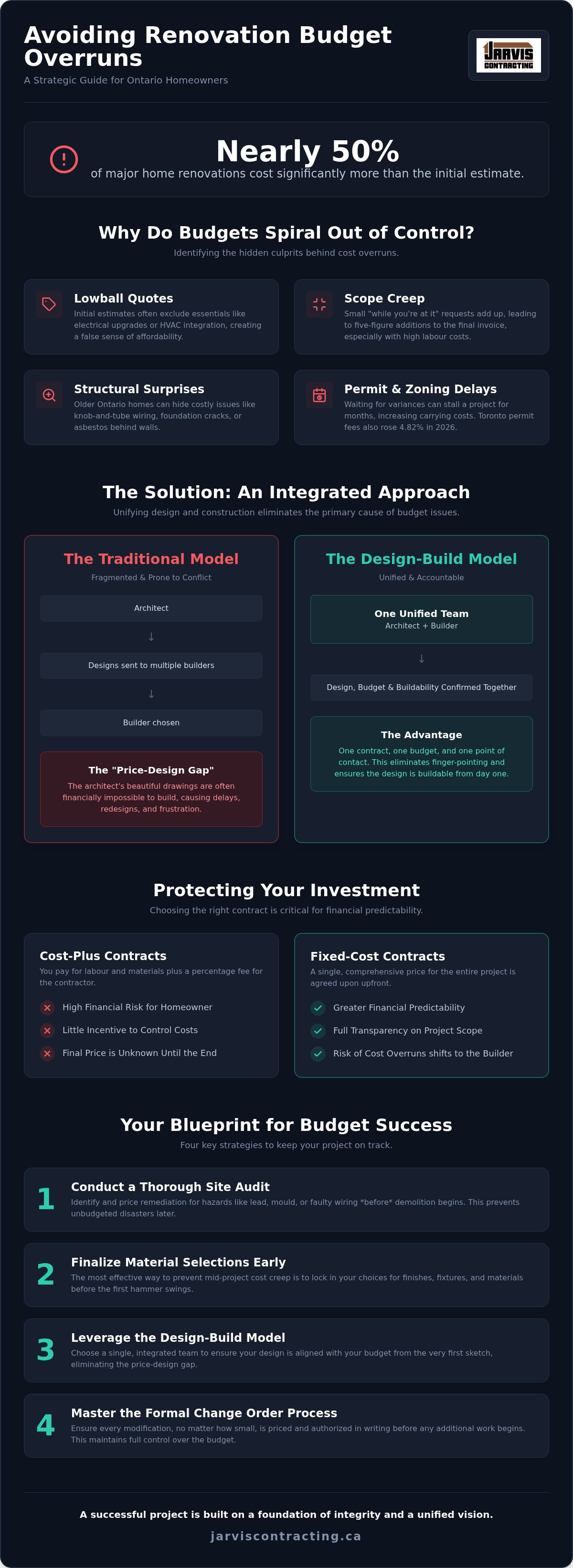
A renovation budget is more than a spreadsheet; it's a promise of what your future home will cost. If that roadmap is missing half the terrain, you'll inevitably get lost. Many homeowners fall into the "lowball quote" trap because they don't realize that a surface-level estimate isn't a comprehensive plan. A foundational step in understanding cost estimates is recognizing that an initial figure often excludes the unseen essentials. These might include electrical panel upgrades or modern HVAC integration required by the latest safety standards.
Scope creep is another silent budget killer. It often starts with a simple "while you're at it" request and ends with a five-figure addition to the final invoice. In the 2026 Ontario market, where luxury finishes and labour costs remain elevated due to a projected shortfall of 300,000 tradespeople, even small changes carry a heavy price tag. Learning how to avoid renovation budget overruns requires a disciplined approach to the original plan and a partner who isn't afraid to be honest about costs upfront.
The High Cost of Structural Surprises in Ontario
Older homes in the Durham Region and Toronto's historic pockets often hide secrets behind their lath and plaster. You might find knob-and-tube wiring, foundation cracks, or even asbestos that wasn't visible during a casual walkthrough. These aren't just inconveniences; they're significant financial risks. A thorough pre-construction site audit is your best defence. By identifying environmental hazards like lead or mould before the demo crew arrives, you can price the remediation into the contract. This prevents the anxiety of "opening up the walls" only to find an unbudgeted disaster.
Permit and Zoning Delays: The Invisible Budget Eaters
Time is quite literally money during a major renovation. As of January 1, 2026, the City of Toronto implemented a 4.82% fee increase for building permits. Beyond the fees, the real cost lies in the waiting. Zoning variances and Committee of Adjustment delays in York Region or Toronto can stall a project for months. This increases your carrying costs and pushes your construction timeline into more expensive seasonal labour brackets. Having an integrated architectural team that understands the 2024 Ontario Building Code and local municipal bylaws is essential. They ensure your designs meet current standards, such as the expanded carbon monoxide alarm requirements effective in 2026, preventing costly revisions after the application is submitted.
The Design-Build Advantage: Eliminating the Price-Design Gap
Many homeowners start their journey with an architect, only to find that the beautiful drawings they've paid for are financially impossible to build. This "price-design gap" is the primary cause of frustration and abandoned projects. The Design-Build model solves this by uniting the architect and the builder under a single contract and a unified budget. It's a strategic shift that fundamentally changes how to avoid renovation budget overruns. By having the construction team present during the design phase, technical buildability is confirmed before the first permit is even filed.
Data from the Improving America's Housing 2025 report highlights that rising material costs and labour shortages continue to pressure renovation budgets across the continent. In this environment, "Value Engineering" becomes essential. This is the process of adjusting material specifications and structural choices during the design phase to meet a specific budget target. Instead of receiving a shocking quote after weeks of planning, you work with a team that balances aesthetic desires with financial reality in real time.
One Point of Contact for Project Accountability
Efficiency thrives when communication is direct. In a traditional model, the homeowner often acts as a referee between an architect who wants a specific look and a builder who says it isn't practical. A single project manager oversees both the creative and technical aspects of your home, ensuring that no detail is lost in translation. This integrated approach is one of the key Design-Build benefits for Ontario homeowners, as it eliminates the finger-pointing that often leads to expensive change orders.
Pre-Construction Feasibility: Testing the Budget Early
Transparency starts long before the demo crew arrives. At Jarvis Contracting, we use early-stage cost estimating to ensure we aren't designing a home you cannot afford. We implement regular budget checkpoints throughout the design process to keep expectations grounded. Pre-construction feasibility is the bridge between architectural vision and financial reality. If your heart is set on a specific layout, we'll tell you exactly what that means for your bottom line today, not six months from now. If you're ready to start planning with a team that respects your investment, our major renovation services can help you find that perfect balance.
The Fixed-Cost vs. Cost-Plus Debate: Which Protects Your Wallet?
The contract you sign is the most powerful tool in your arsenal when deciding how to avoid renovation budget overruns. In Ontario's current market, homeowners typically choose between fixed-cost and cost-plus agreements. A fixed-cost contract provides a high level of predictability because the price is locked in based on a finalized design. This model is often the gold standard for major renovations; it shifts the risk of labour inefficiencies or material price fluctuations onto the builder. Conversely, cost-plus contracts, where you pay for "time and materials" plus a markup (often between 15% and 25%), leave you vulnerable to market volatility. While cost-plus might seem flexible for complex heritage restorations where the scope is difficult to define, it rarely protects your wallet as effectively as a firm, upfront price.
Predictability in pricing isn't just about the final number; it's about the depth of the planning. At Jarvis, we've found that the more time we spend on the details before the first hammer swings, the fewer surprises we encounter later. This methodical approach ensures that your investment is respected and your vision is realized without financial strain. It's about building a relationship based on trust and clear expectations.
Defining the Detailed Scope of Work
A vague quote is the architect of a budget disaster. If your contractor provides a two-page summary for a whole-home remodel, they've likely missed several essential details. A truly professional scope of work is often twenty pages or more, detailing every fixture, finish, and labour hour. You should look for specific tips to save money on home renovations, such as scrutinizing "allowances." An allowance is a placeholder for items not yet selected, like tiles or flooring. If a builder sets these placeholders too low, you'll face an immediate overrun the moment you choose a quality product that actually fits your home's aesthetic. A comprehensive budget also accounts for the "unseen" costs of construction, such as site protection to preserve your existing floors and professional waste management fees.
The 15% Contingency Rule for Ontario Renovations
Even with a fixed-price contract, you must prepare for the unexpected. We recommend a 15% contingency fund for all major Ontario projects. This isn't extra profit for your builder. It's a dedicated safety net for the "surprises" we discussed earlier, like hidden structural issues or mandatory code updates. For a successful project, this fund should remain liquid and accessible throughout the build. It gives you the confidence to handle necessary changes without stalling the timeline or compromising on quality. When you work with experienced major home renovation contractors in Ontario, they'll help you manage this fund responsibly, ensuring your investment is protected from start to finish. This disciplined approach to financial planning is what separates a stressful renovation from a rewarding home transformation.
Practical Strategies to Prevent Mid-Project Cost Creep
Even with a solid contract, the construction phase presents new challenges that require active management. Managing expectations is vital, especially since labour costs in the GTA are heavily influenced by regional demand. Research indicates that Ontario will require approximately 75,000 new workers in the construction industry over the next decade. This shortage means that project delays aren't just frustrating; they're expensive. Understanding how to avoid renovation budget overruns during the build phase requires a commitment to proactive decision-making and rigid administrative discipline. It's about staying one step ahead of the schedule rather than reacting to it.
Front-Loading Your Decisions
Late-stage changes are the primary cause of budget overruns in custom builds. Choosing your tiles, flooring, and fixtures before the first hammer swings prevents the "domino effect" of delays. In 2026, material orders still face long lead times, often stretching several months for bespoke luxury items. If a selection is made too late, it can disrupt the entire labour schedule. This leads to "standby" costs or the loss of a specialized trade's window of availability. Your Design-Build firm should provide a comprehensive selection schedule at the very start of the project. Following this timeline ensures that materials arrive on-site exactly when the craftsmen are ready for them.
The Discipline of Change Orders
A Change Order is a formal amendment to the contract that protects both the homeowner and the builder. It's easy to fall into the trap of verbal agreements, especially during a friendly site walkthrough. However, you should never accept a "we'll settle it at the end" promise for extra work. Small $500 modifications can seem insignificant on a $250,000 project, but their cumulative effect is often what pushes a budget past its breaking point. Every modification must be signed and priced in writing immediately. This transparency ensures that you always know exactly where your investment stands. It eliminates the "bill shock" that often occurs during the final project closeout.
Consistent communication is the final piece of the puzzle. Weekly site meetings allow you to address small misunderstandings before they become $5,000 mistakes. These rhythms build the quiet confidence that comes from being fully informed about the progress of your home. If you're looking for a partner who prioritizes this level of detail and financial integrity, contact Jarvis Contracting to discuss your 2026 renovation goals. We treat your budget with the same respect we give to our own family legacy.
The Jarvis Legacy: Integrity in Ontario Home Construction
At Jarvis Contracting, we don't view a project as a mere transaction; it's a personal reflection of our own standards. As a second-generation, family-owned firm, we treat your renovation budget with the same respect we give our own family's resources. We've found that the ultimate secret in how to avoid renovation budget overruns is a steadfast commitment to transparency from day one. This isn't just about the numbers on a page. It's about a protective, respectful attitude toward the environment you call home. When you trust us with a major renovation, you're gaining a partner who values tradition and foundational skills as much as modern efficiency.
Quality and craftsmanship are often the best insurance against future financial strain. While a cheaper quote might seem attractive today, sub-standard work leads to repair costs and structural failures that can haunt a homeowner for decades. We believe in doing the work right the first time. Our local knowledge, spanning from the Durham Region and Markham to the Muskoka region, prevents the logistical surprises that often derail budgets. Whether it's navigating unique lakeside building requirements or managing complex deliveries in the GTA, our experience ensures that every detail is accounted for before the build begins.
A Family-Operated Approach to Major Renovations
Since our founding in 2007, James Jarvis has maintained a hands-on leadership style that ensures our core principles are present on every job site. We've built deep roots in the GTA, and that history allows us to provide a level of reliability that larger corporate firms often lack. We understand that a major transformation is a significant emotional and financial investment for your family. By offering a single point of contact, we eliminate the stress of fragmented communication. If you're looking for a detailed roadmap for your next project, our guide on Whole Home Remodel Toronto: A Step-by-Step Guide to Planning and Phasing provides the clarity you need to start with confidence.
Ready to Plan Your Fixed-Price Renovation?
Experiencing the Design-Build difference means moving away from the anxiety of "hidden costs" and toward a unified, professional vision. Our in-house architecture and design team works tirelessly to align your creative goals with your financial reality, ensuring your dream home is actually buildable within your means. We invite you to see how our methodical, steady process can turn a complex renovation into a rewarding experience. If you're ready to discuss a custom home, a major addition, or a full-home transformation in Whitby, Oshawa, or Toronto, we're here to help. Contact Jarvis Contracting today to schedule a consultation and take the first step toward a beautifully executed, on-budget home.
Building Your Future with Lasting Confidence
A major home transformation is a significant investment in your family's future comfort and legacy. While the complexities of the 2026 Ontario market can feel daunting, mastering how to avoid renovation budget overruns is achievable with a disciplined framework. By integrating architecture and construction through a Design-Build model, you eliminate the friction between design and reality that often leads to costly surprises. Establishing a meticulous scope of work and maintaining a 15% contingency fund ensures your project remains a sanctuary rather than a financial burden.
Since 2007, Jarvis Contracting has provided a steady, single point of contact for homeowners across the GTA and Durham Region. As a family-owned firm, we treat every whole-home remodel and addition with the same integrity we would apply to our own property. Our methodical approach ensures that your vision is realized with precision and respect for your investment. Start your stress-free renovation journey with Jarvis Contracting today. You deserve a home that reflects your standards without the stress of unmanaged costs. Let's build something lasting together.
Frequently Asked Questions
How much contingency should I really set aside for a whole-home renovation in Ontario?
You should set aside a minimum 15% contingency fund for a major Ontario renovation. While some sources suggest 10%, our experience in older GTA neighbourhoods shows that 15% provides a safer buffer for hidden structural issues. This fund acts as a financial safety net rather than extra profit for the builder. It's essential to keep these funds liquid so you can authorize necessary repairs without stalling the construction schedule or compromising on quality.
What is the biggest cause of budget overruns in custom home builds?
The primary driver of unexpected costs is fragmented planning between architects and builders. When a design is created without real-time construction input, the resulting quotes often exceed the homeowner's expectations. Additionally, late-stage material selections and verbal "while you're at it" changes can add thousands to the final bill. Learning how to avoid renovation budget overruns starts with finalizing every detail, from tiles to fixtures, before the first hammer swings on your site.
Are fixed-price contracts actually better than cost-plus for major remodels?
Fixed-price contracts are generally superior for major remodels because they offer price predictability and transparency. In a market with fluctuating material costs, a fixed-price agreement shifts the risk of price spikes to the contractor. Cost-plus contracts often lead to "bill shock" because you're paying for every hour and material plus a markup. Unless your project scope is impossible to define, a detailed fixed-price contract is the most effective tool for protecting your investment.
Can I save money by acting as my own general contractor?
Acting as your own general contractor rarely saves money on a major project. Professional firms have established relationships with trades and receive preferred pricing on materials that homeowners cannot access. Without a deep understanding of the 2024 Ontario Building Code, you risk costly failed inspections and scheduling errors. A single mistake in trade sequencing can lead to weeks of delays, ultimately costing you more in carrying costs than the fee of a professional firm.
How do permit delays in the GTA affect my renovation budget?
Permit delays create "invisible" budget eaters through increased carrying costs and seasonal labour shifts. In Toronto, the 2026 permit fee increase of 4.82% is just the beginning; the real cost is the time spent waiting for approvals. If a project is delayed by six months, you may miss your window with specific trades, forcing you to hire more expensive alternatives. An integrated design team prevents these delays by ensuring all drawings comply with local zoning bylaws.
What happens if we find mould or asbestos during the demolition phase?
Discovering environmental hazards like mould or asbestos requires immediate professional remediation to ensure your family's safety. These issues are common in older homes across Markham and Oshawa. When these surprises occur, your contractor will issue a formal Change Order to cover the specialized removal costs. This is exactly why we insist on a 15% contingency fund. Handling these issues properly at the demolition stage prevents much more expensive repairs and health concerns later.
Is it possible to renovate a house in Ontario without any budget overruns?
It is absolutely possible to complete a renovation on budget when you follow a disciplined Design-Build process. Success depends on two factors: a fixed-price contract based on a detailed scope of work and a commitment to zero mid-project changes. By making all selections upfront and utilizing pre-construction feasibility audits, you eliminate the variables that typically cause costs to balloon. Transparency and honesty from your builder are the foundations of a project that finishes exactly where it started.
How does the Design-Build model help with budget transparency?
The Design-Build model provides transparency by uniting architecture and construction under one roof. Instead of getting a design from one person and a price from another, you receive integrated feedback throughout the planning phase. This eliminates the price-design gap and ensures your vision aligns with your financial goals. Having a single point of contact also means there's no finger-pointing between parties, which is a key strategy for those wondering how to avoid renovation budget overruns.


Comments